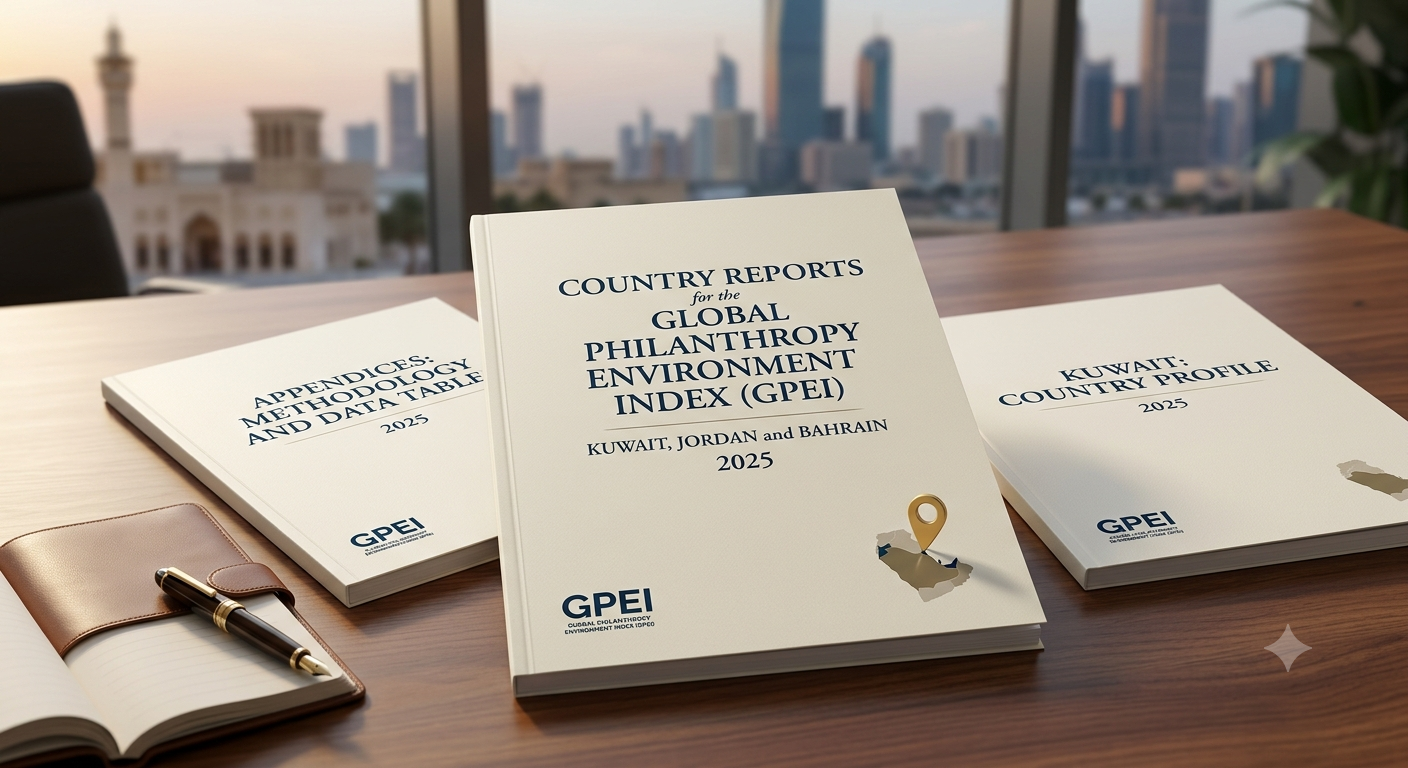
Country Report for Kuwait, Jordan, and Bahrain
The Global Philanthropy Environment Index (GPEI) is one of the leading international references for measuring and analyzing the legal and regulatory environment that impacts philanthropic work. It stands as the largest and most comprehensive global effort to document the state of worldwide philanthropy and the factors that enhance or hinder its success. It provides the tools global leaders need to understand how and where the philanthropic environment is changing and evolving, and more importantly, how to maximize philanthropy’s capacity to help solve urgent challenges. This gives it paramount importance at a time when the role of philanthropy in driving innovation during crises remains under-documented and not well understood.
The index evaluates the philanthropic environment of countries on a five-point scale (1 to 5) across six core factors: the ease of operating a philanthropic organization, tax incentives for giving, cross-border philanthropic flows, the political environment, the economic environment, and the socio-cultural environment for philanthropy.
The first edition of the index was published in 2015 by the Hudson Institute. Since 2017, the Indiana University Lilly Family School of Philanthropy has taken over updating and publishing the index regularly.
Jordan
Regarding Jordan, this is the third time it has participated in this important index, following the 2018 and 2022 editions. Jordan’s overall score in the 2025 Global Philanthropy Environment Index witnessed a decline, dropping to 3.18 compared to 3.54 in the 2022 index. On the level of sub-indicators, the score for “ease of operating a philanthropic organization” decreased to 2.33 compared to 3.00 in the previous index, and the score for “cross-border philanthropic flows” fell from 3.50 to 3.00. Meanwhile, the sharpest decline was in “tax incentives,” which dropped from 4.25 to 3.75, indicating complexities in the incentives provided.
The report concluded with several recommendations to improve the philanthropic environment in Jordan, which included: amending the Associations Law No. 51 of 2008 to facilitate philanthropic work and achieve greater transparency; enhancing coordination between government agencies and charities through independent oversight mechanisms; and establishing a national fund to provide sustainable revenue sources for charities.
State of Kuwait
Regarding the State of Kuwait, this is also the third time it has participated in this important index, following the 2018 and 2022 editions. The State of Kuwait’s overall score in the 2025 Global Philanthropy Environment Index showed improvement, rising to 3.94 compared to 3.70 in the 2022 index. On the level of sub-indicators, the score for “ease of operating a philanthropic organization” rose to 3.40 compared to 3.33 in the previous index, while the score for the “political environment” increased from 3.75 to 4.10. The most significant improvement was seen in the “socio-cultural environment,” which rose from 4.00 to 4.50, reflecting the positive impact of social traditions in the State of Kuwait on philanthropic work.
The report concluded with several recommendations to improve the philanthropic environment in the State of Kuwait, including: integrating government regulation with creative freedom in philanthropy; uniting efforts and improving coordination among charities; and utilizing artificial intelligence and digitization to improve operational processes.
Kingdom of Bahrain
As for the Kingdom of Bahrain, this was its first official participation in this international research project, as it had not participated in previous editions.
The Kingdom of Bahrain achieved an overall score of 3.47 out of 5, while the results for the six core factors were as follows: ease of operating philanthropic organizations: 3.3; tax incentives: Not Applicable (N/A) due to the absence of income or corporate tax in Bahrain; cross-border philanthropic flows: 2.0; political environment: 3.5; economic environment: 4.0; and socio-cultural environment: 4.5.
The report concluded with three main recommendations to strengthen the philanthropic environment in the Kingdom of Bahrain: increasing government support for civil society organizations and developing legislation that enhances the role of the philanthropic sector as a complementary sector to both the public and private sectors; exempting the philanthropic sector from electricity fees and Value Added Tax (VAT); and establishing a specialized center for studies and research related to philanthropic work.
It is worth noting that the results of the three countries fell within the 3.5 to 3.99 tier, which also included Saudi Arabia, the United Arab Emirates, and Qatar.
Report Authors:
- Jordan Report Authors: Dr. Samir Abu Rumman (Visiting Professor at George Mason University), Dr. Abed Ayoub (Founder and CEO of United Mission for Relief and Development – UMR, USA), and Sabri Al-Ramahi (World of Opinions Center for Polls).
- Kuwait Report Authors: Dr. Samir Abu Rumman (Visiting Professor at George Mason University and Member of the Scientific Committee at the Center for Gulf and Arabian Peninsula Studies at Kuwait University), Dr. Abdul Razzaq Al-Shaiji (Professor at Kuwait University), Dr. Sarah Yehia (Cairo University), and Sabri Al-Ramahi (World of Opinions Center for Polls).
- Bahrain Report Authors: Dr. Samir Abu Rumman (George Mason University), Dr. Mohammed Al-Ansari (University of Bahrain), and Sabri Al-Ramahi (World of Opinions Center for Polls).
Report Download Links:
- To download the Jordan report:
To download the Kuwait report:
https://scholarworks.indianapolis.iu.edu/items/6930a5bd-60d3-46d6-97cc-3b1dc60791b8
- To download the Bahrain report: