
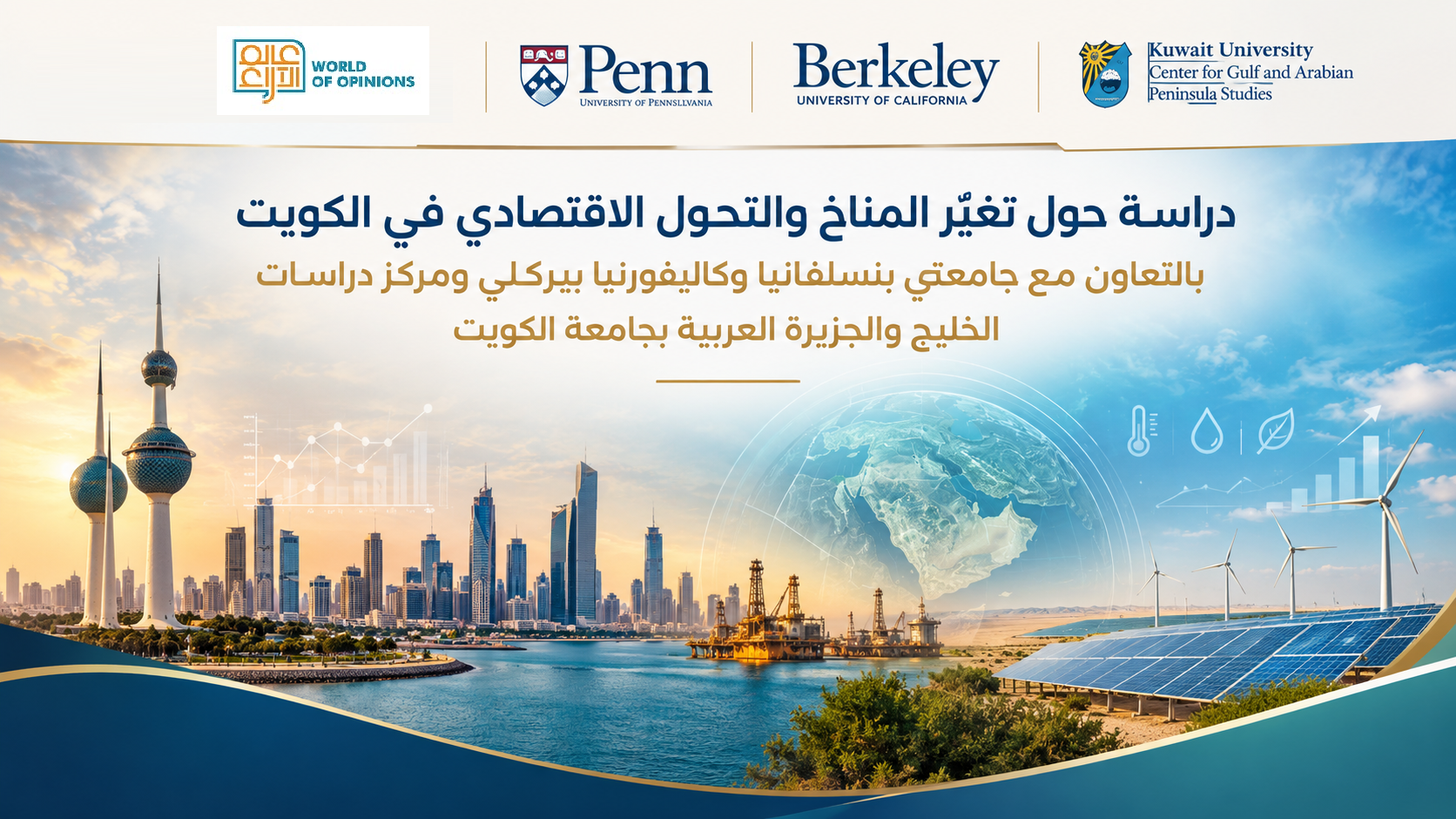
World of Opinions for Polls – Kuwait conducted the study in cooperation with the University of Pennsylvania, the University of California, Berkeley, and the Center for Gulf and Arabian Peninsula Studies at Kuwait University, between April 20 and July 1, 2025.
The study aimed to explore the perceptions of Kuwaiti citizens, as well as Arab and foreign residents, regarding the impacts of climate change and the economic transformation plans under Kuwait Vision 2035. It also aimed to assess the community’s level of awareness of environmental challenges and the extent of support for international cooperation to confront climate change and reduce reliance on oil. Furthermore, it focuses on understanding the impact of economic transformation on society, including enhancing the roles of women and providing job opportunities in non-oil sectors.
Despite the existence of a large number of studies addressing climate change and economic diversification in Kuwait, this topic has not been previously addressed through survey-based studies exploring the opinions of Kuwaiti citizens and residents in Kuwait in general. Hence, this research study gains significant importance in understanding the attitudes and opinions of Kuwaiti citizens and residents toward contemporary environmental, social, and economic issues, focusing on the impacts of climate change and economic transformation plans within the framework of Kuwait Vision 2035. This is achieved by providing accurate and comprehensive data that helps decision-makers develop policies reflecting the needs and expectations of society, thereby contributing to enhancing the effectiveness of national plans for sustainable development. Additionally, the study provides an opportunity to evaluate the level of societal awareness of climate and economic challenges, and analyze the extent of citizens’ support for international cooperation and reducing dependence on oil as a primary source of income. This reinforces national efforts toward achieving a diversified and sustainable economy, making the study an important tool for decision-makers and researchers alike.
The study’s working team included: Dr. Sarah Bush (University of Pennsylvania), Dr. Amanda Clayton (University of California, Berkeley), Dr. Ameera Alhassan (Head of the United Nations Human Settlements Programme – UN-Habitat Mission for Kuwait and the GCC), Prof. Dr. Yaqoub Youssef Al-Kandari (Director of the Center for Gulf and Arabian Peninsula Studies), Dr. Samir Abu Rumman (General Supervisor of World of Opinions, Member of the Scientific Committee of the Center for Gulf and Arabian Peninsula Studies at Kuwait University, and Visiting Research Professor at George Mason University)
The study included an opinion poll conducted between May 13 and July 1, 2025, targeting a sample of Kuwaitis, as well as Arab and foreign residents in the State of Kuwait. Twelve male and female researchers participated in the fieldwork, resulting in 2,002 completed questionnaires from the target sample across all six governorates of Kuwait. Additionally, to obtain qualitative data, four focus groups consisting of Kuwaiti citizens were held (two for men and two for women).
Dr. Samir Abu Rumman, the General Supervisor of the Center, presented the study in a research paper titled “Studying Climate Change and Economic Transformation Policies in Kuwait: Results and Recommendations” during the WAPOR Asia Pacific Eighth Annual Conference that was held at Rikkyo University in Tokyo, Japan, between November 21–23, 2025.